
SEXUALITY
All identity issues, frustrations, opinions, discrimination, etc. – all issues based on or related to sexuality in any way or form – can be solved overnight. For the simple reason that we, people, created them in the first place. The problem lies in the fact that we cannot make sense of the world without labels, and that we even correlate these labels to predictable behaviours, and vice versa.
When we accept that sexuality is a personal, unlabelable thing – a vastly personal preference, nothing more – you can see that all the value, positive and negative, we attribute to it becomes obsolete. And with that, all problems go away. What’s left? The sheer, limitless awesomeness of being who you truly are. Here’s my plea – manifesto, if you will – on what sexuality is and how we should see it.
TL;DR
Sexuality is your own unique, beautiful, but above all very, very personal spot on a globe – no matter is, isn’t, will be, was or what you want to have between your legs. Fuck labels, stereotypes, and the pressure to conform – the pressure to try to mould yourself into a square box. Just feel what you feel, be who you are, and don’t let anyone, including yourself, tell you any different. Freedom to love who you want to love, freedom to explore who you want to love without pointless constraints. Achieving true equality. True equality by not giving a fuck in the first place.
What remains? Everything else. True equality based on sexuality, where people aren’t woke, progressive, traditional, gay, straight, queer, allies or whatever. They are just people. People who love and are allowed to love who they want to love, and who get to enjoy the joy of figuring out what that means.

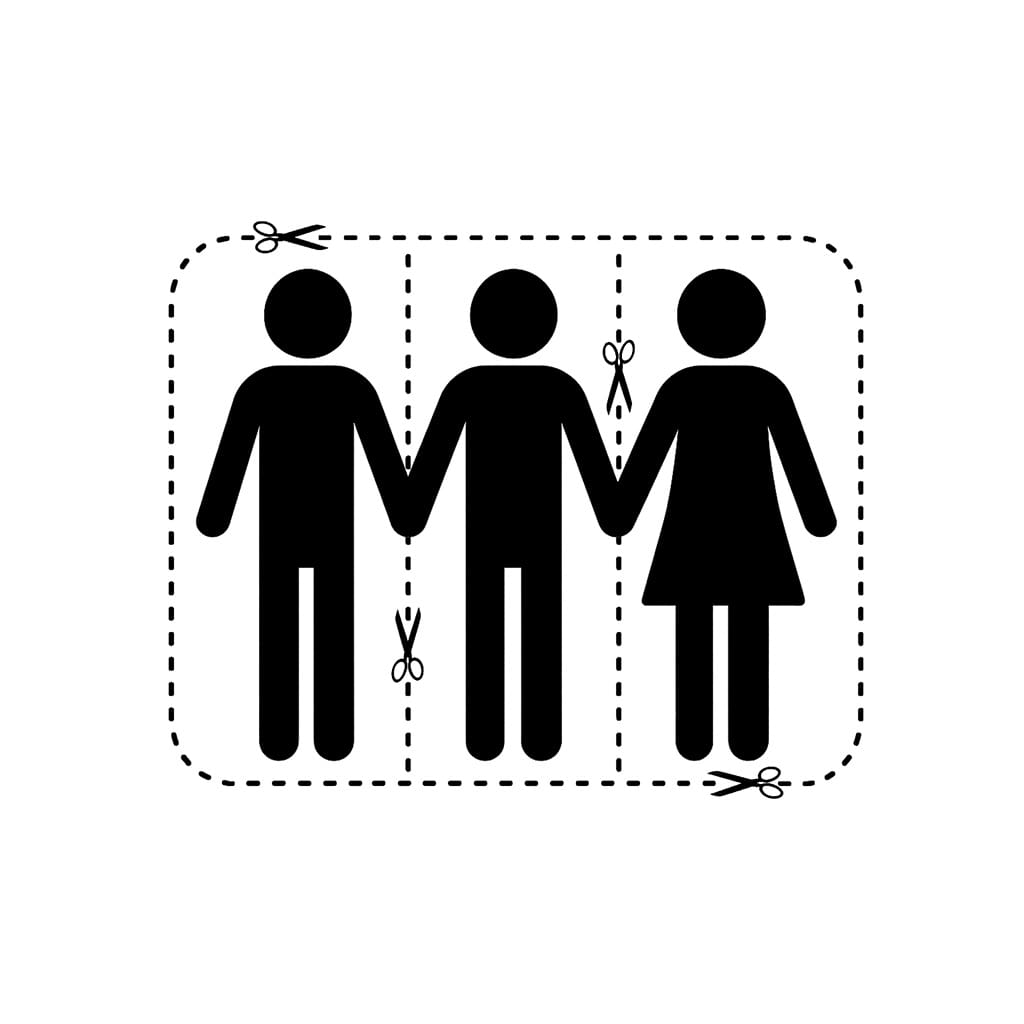
Now we think it’s more like this.
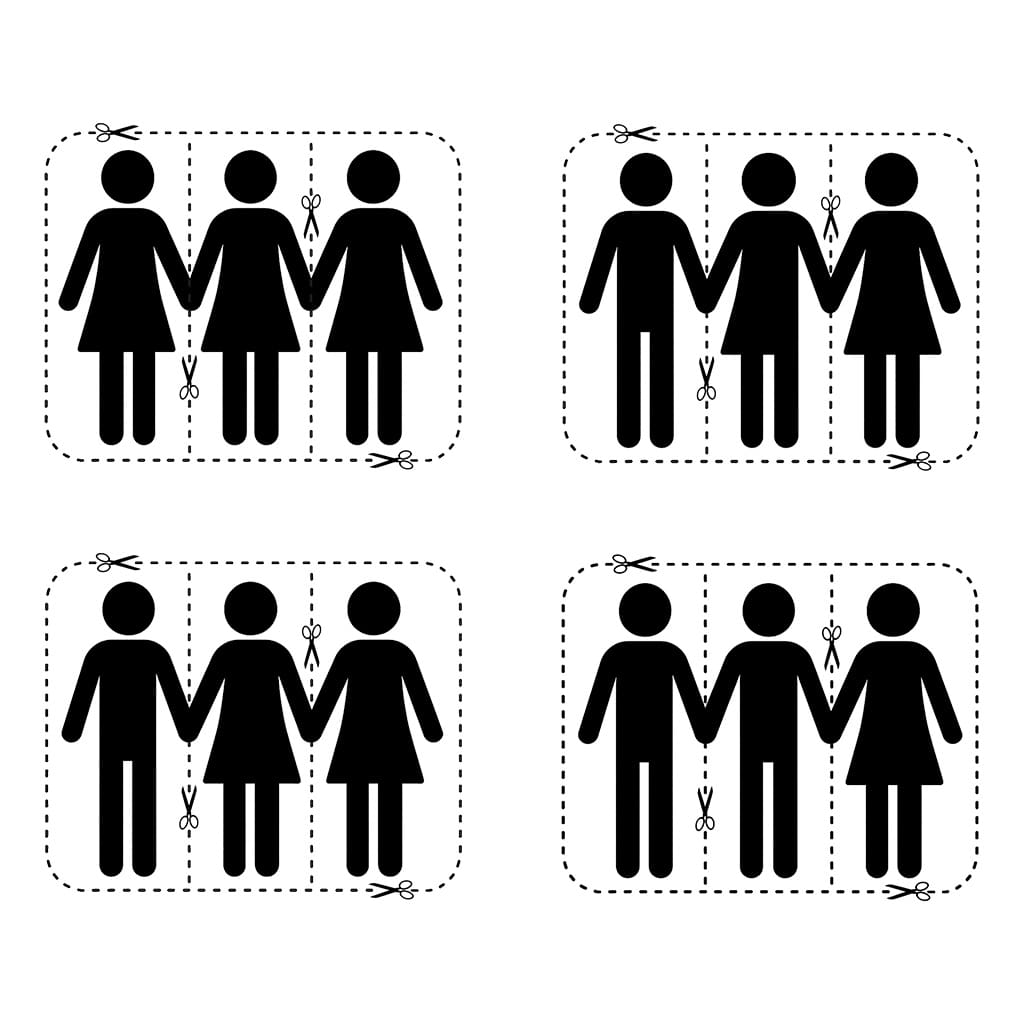
Turns out to be this.

STATUS QUO: LABELS EVERYWHERE
Some societies do it rather bluntly: either you’re straight or you’re wrong. Others are more subtle or try to accommodate all categories of sexuality, but all societies label. And if you don’t even fit neatly into “man” or “woman”, the pressure to label yourself – and be labelled by others – only gets worse. As a result, you’re forced to label the unlabelable. Forced to ask yourself questions to define something as undefinable as your sexuality.
We take this labelling exercise to the point where we think we can understand what kind of behaviour comes with it. For example, when society brands you a man and you like others who also happen to have a penis. It doesn’t stop there, does it? Your label often comes with a presumed set of behaviours. Being more feminine, flamboyant, enjoying fashion. When you happen to have a vagina and you happen to enjoy the occasional company of someone else’s vagina, you probably like flannel shirts, outdoorsy activities, short hair and are more masculine than you should be as someone who has been branded a woman.
None of this even begins to capture what happens if your current label is trans, non‑binary, or, simply put, not conforming to cis‑gender labels. Then it’s not just “who do you love?” It’s “are you even allowed to exist as you are?” before anyone cares about who you’re into.
The opposite is true as well. If you have a vagina and you like to wear a flannel shirt and enjoy riding a motorbike, people might think you’re gay. When you’re a man and you’re more feminine than society thinks you should be, people will also think: gay. Nonconformity to societal standards of how to act based on your sex or gender often leads to various degrees of discrimination, including discrimination based on sexuality.
As a result, people – especially at a young age – are heavily influenced by stereotypes. They often believe that when they find someone attractive, they’re not just choosing a partner but also conforming to an expected stereotype.
Discrimination in Degrees
The severity of discrimination based on sexuality varies heavily. In total, there are 65 countries where consensual same‑sex relationships are illegal. That’s about 1 in every 3 countries in the world. Besides outright discrimination from your fellow citizens, by law you might find yourself fined, beaten, prosecuted or put to death.
In most societies you’re simply gay, bi, pan, etc., often summarised as queer or LGBTQ+ (both are broader and encompass more than just sexuality), and you will have the same legal rights. You’re probably expected to adhere, at least to some degree, to the stereotypes that come with your label. Annoying, yes. Offensive, sometimes. Aggressive, no. Well, mostly. Because even in some of the most tolerant societies, you might still get punched in the face for holding your same‑sex partner’s hand. It remains true that most people who are open about a non‑heterosexual sexuality have experienced some kind of maltreatment, ranging from angry looks to outright assault.
Forms of discrimination are not just found in the behaviour of a few who cannot handle others not having the same sexuality. It’s mostly vested in the habits and beliefs of many. It can be as simple as having to “come out”, inadvertently stating that having a sexuality aimed at the opposite sex is the default and that others have to identify as different.
Discriminatory behaviour is also shown by people who have been labelled. People can feel the need, perhaps to regain control over who they are, to proudly and loudly express that they are gay, and to follow the stereotypes society may have forced upon them. People who are labelled based on their sexuality (or anything else, for that matter) can become the stereotype they are expected to be. Something that is also true for people whose sexuality fits the default, feeling the need to adhere to your gender role within the relationship. In some ways, this renders the discriminatory stereotypes that created this segregation in the first place true, making it harder to break the status quo.
Positive AND Negative Discrimination
People tend to think that positive affirmation of diversity is the key to solving discrimination and bigotry. But positive and negative discrimination are two sides of the same coin: unjustly correlating sexuality to behaviour. Not just someone who says that homosexuality is a sin is a bigot. A man who claims to be more flamboyant, sassy or fashionable because he’s gay is also guilty of discrimination, and should be called a bigot as well. Both are discriminatory. Neither achieves equality. Better said, neither strives to achieve equality.
The bottom line is, we label sexuality in a world where we can’t even get sex and gender right. And when the label is found, we start doing all sorts of things – to each other and to ourselves. When you think about it, what is the actual point? And, with that, is it even possible to label sexuality? What would happen if there were no pressure, no biases, no stereotypes? No labels?
PROBLEM
If I ask you to tell me where the beginning and end of a round object are, could you do it? Could you tell where a ball, a globe, or any other round object starts, where the middle is, and where it ends? This is pretty much what we force upon ourselves and others when we label sexuality. It’s a continuum: nobody is straight, nobody is gay, or bi, or asexual, or pansexual, or any other label we have come up with to try to define where we are on this round object.
We are sexually interested, to various degrees, ranging from almost never to almost always, in others, in ourselves, and sometimes even in objects. This sexual attraction can be physical, it can be emotional, usually both. It fluctuates, it varies, it can be intense, it can be absent, often tied to how you physically and emotionally feel. Pretty much an endless array of flavours that also happen to be situational, up to the point of fluidity.
We claim to understand this to the point of being able to label it. Perhaps because, for some of us, our sexuality points in a rather outright direction. But even in these outright cases – for example, where someone has never found someone of the same sex attractive – this person still can’t say they fully understand their desires. Nobody knows. Not until you experience that feeling: that feeling of joy, euphoria, that intense, all‑consuming feeling of love, or just raw sexual attraction. But even when you do, you still don’t know exactly what it is. Was it that smile? That joke that made you laugh so hard? Was it that hand you felt brushing against yours? Or was it just that killer body you saw on the beach?
The Paradox of Understanding Feelings
When we embrace the fact that sexuality is so personal that it’s beyond the point of comprehension, we finally come close to understanding it. You don’t have to understand it. You just have to feel it. Just feel, without being held back by bullshit, stereotypes, expectations and pretty much any social construct there is. Just feel and let your mind (or genitals, if you must) guide you to who you find attractive. Don’t ask yourself why. Just accept it. Only then can you come close to understanding what your sexuality is.
Is this easier said than done? Fuck yes! It’s more often than not impossible to know what is and isn’t influencing the way you feel, especially when the context is so heavily distorted by discriminatory assumptions. And that’s not even considering that deviating from the status quo usually involves a lot of unwanted feedback and opinions. So, let’s take it step by step and fix that.
SOLUTION
STEP 1: LABELS ARE FOR PRODUCTS. NOT SEXUALITY.
Various scientific studies try to define sexuality. At first, they categorised people’s sexuality into the categories straight (attraction to the opposite sex), gay (attracted to the same sex) or bi (attracted to both sexes) (link). Later, the acceptable idea became a spectrum, which is going in the right direction, but even this spectrum still revolves around the notion of gay and straight being on opposite ends, embodied in terminology such as “mostly straight” and “mostly gay” (link). Still a grotesque oversimplification of personal feelings and desires.
When we strive to label everyone, we don’t just need a ton of labels – up to the point that it’s not even feasible any more – but also labels that are fluid, if that’s even possible. What if you’re attracted, mostly, to people of the opposite sex, but only when you can connect on an intellectual level, and you don’t have much, but some, need for penetrative sexual intercourse, but you do like to hug and feel the other? What if you’re attracted to people of the same sex, but also like to make out with people from the opposite sex, and you’re turned on mostly by people who are a bit older? And what if this changes? Permanently or temporarily? And that is not even including any views on sex and gender identity.
The Hormone Question (and why it shouldn’t even be asked)
Other studies try to find the origin of sexuality and suggest that there might be a correlation between certain hormones and your sexuality, and that influences during pregnancy can be decisive for one’s sexuality (link). Fascinating stuff, but, besides the fact that this idea is inadvertently built upon the foundation of being able to label sexuality, it’s not very practical. Even if it’s possible to say something sensible about your sexuality based on hormones or events during pregnancy, it’s not going to do you much good. Let me illustrate.
What if your hormone structure tells you that someone is attractive, but this person turns out to be openly racist? Are you now still obliged to uncork the Chablis and just pray said person doesn’t want to roleplay “KKK member and the impossible love of a person of colour” again?
What we need to accept as a society, as people, is that sexuality is abstract, intangible, and above all, very, very personal. It’s your own personal spot on the perfectly round globe. With that, your sexuality is in fact exactly the same as that of the next person in the sense that it’s just another spot on that globe. Each person’s sexuality is so specific and personal that it becomes pointless to try to differentiate between them, let alone label them. The only label you need, you already have – your name.
Individual Experience as the Only Definition
Does this mean you just have to get lucky? That there is no point in figuring out what your type is? Does this mean you cannot have any preferences? Of course not. Dating is and will always be somewhat of a lottery, but by doing it you’ll figure out what things you like about others and what things you don’t like.
Besides dating, clues about your preferences can appear anywhere. Perhaps you felt a sudden urge when Margot Robbie stood in that doorway in The Wolf of Wall Street. Perhaps it’s Brad Pitt in Fight Club that’s keeping you up at night. Or were your teenage years partly shaped by Rosario Dawson in Rent? Perhaps all. Perhaps neither. Just feel. Or, more importantly, accept what you feel.
Perhaps you feel that you can connect with others who feel the same, and you can both share how Brad Pitt made you feel. But perhaps your sexuality turns out to be vastly different from the others around you. So what? It’s not about being different, it’s not about being the same. There are differences. There is overlap.
To put it bluntly, and somewhat negatively, I believe that we label everything due to a mixture of ignorance and arrogance. Ignorance in the sense that we’re not able to understand the world around us if we don’t put a label on it. Arrogance in the sense that we think we actually can label something as intricate as someone’s sexuality. Just accept that you don’t understand it and feel. That’s the only way to understand it.
What’s most important about this is the fact that when you don’t have a label, you cannot act outside of what is expected of you, including what you expect from yourself. There is no right and no wrong. There is no label. There is nothing you have to conform to. There is just you, without any distractions. No expectations. No pressure. We tend to think that the label is the solution – to finally figure out that you’re gay, pan, etc. – but it’s in fact the problem.
People think it helps us to label. And in some ways it does. It helps us, in today’s society at least, to understand which group we belong to. We think it helps us to define our sexual preferences and connect with others who feel the same. And perhaps also to find like‑minded people or to set up your Tinder profile. In essence, we use labels to explain to someone (including ourselves) what our preferences are. For some, this is great. They belong. For others, this might not be so great. They feel they have to conform. But for all, it’s them – a round object – being put in a square box. But the question remains: what is the point of the label?
It appears to be answered: you can find a group and identity as part of this group, but in fact it’s not. In fact, the label is a misplaced vehicle upon which groups are formed or chosen. Misplaced in the sense that, for none, it will be more than only a guide to their sexuality and not a definition. But now you’re part of a group based on this label. What if you want to venture outside of the construct of your label? Will this lose you your spot in the group? Do you have to change your Tinder settings? And what if you don’t like the group your label puts you in?
Setting up your Tinder profile
But now you want to set up your Tinder profile. If you zoom out and think about what a dating app does, it lets you find people you want to date. You select men, women or both, and more recently, non-binary, and start swiping. How often do you swipe right? How many of those profiles appeal to you? In most cases, not many. The reason is that the cutoff should not be men or women or both. The cutoff should be based on people you feel attracted to.
So, what if you leave out the presumptions? The biases, the constructs, the sex or gender? Imagine an AI model that doesn’t understand sex or gender. One that learns solely from reading how your body reacts to seeing someone. This model will now show you profiles based on what it learned. Will it still only show you men or women? Perhaps. Perhaps not.
But perhaps this would be the most technology can help you to come close to understanding your sexuality. One that strives to eliminate any fear, shame, presumptions, social constructs – anything other than how you feel. One that’s only possible without labels.
What is key here is that the label is actually stopping us from doing this exercise truly. It’s distorting the dataset with bias. The fact is, without the label you can still use Tinder, but without the bias. You can do it better. Truly better. Due to the biases of the label, the constructs, the failed notion of consequences, having to explain something to yourself and others, people are messing with their own internal dating algorithm.
A wonderful unlabeled world
In fact, without the label you get none of the bad stuff and you can still have all of the good stuff. Going back to forming groups with like‑minded people: the discrepancy lies in the fact that the label is supposed to be fitting for all. To some extent it might be, but it never really is. The label is too simplistic. The common denominator of a close‑knit group is behaviour. We like to mingle with people who enjoy the same behaviours as we do. That’s the key. So, simply looking at a label is not going to achieve that.
Without labels you can still bond over sexuality, talking about what you both learned about what you’re into, how intelligence is more important than a six pack, or how you favour boobs or but or vice versa. You can still be part of something bigger, but you don’t have to commit to anything predefined. Commit to anything other than what you feel is right. Without the label that is supposed to define you, trying to dictate what behaviours, what people you should like, you get freedom. Freedom of choice. There is no explaining if you do, but also no explaining if you don’t. Only logic is left. The logic of unencumbered feeling who and what you’re attracted to. With that the logic that you mingle and connect with people that complement you.
To continue this line: we label people based on sexuality, and this label, in turn, to a certain degree, decides (dictates) who is and isn’t attractive. Call it the receiving end of your label. So, this requires you to also label others as well. To illustrate, when your label finds men attractive, you have to decide what men are. What if someone is transgender and went from being a woman to now being a man? Is this man enough for you? And what defines being a man? Is it a natural penis? Is chest hair enough? The absence of boobs? And what if a woman has no breasts – is she now a man? Or is it the way someone identifies and acts?
Not labelling yourself, and not labelling others, would solve this unnecessary problem. The only question that would remain is: do you find this person attractive? Or better said, how does this person make you feel? No strings, no judgement, no constructs. Just feelings. Are your feelings pointing in the “fuck yes” direction? Go for it! Give it your best opening line. It’s up to you and only you to feel who is and isn’t attractive.
In a less outright manner, we take labelling another step further. Call it social labelling or emotional labelling. Your sexual preferences perhaps less so, but your preferences for a partner aren’t just influenced by someone’s sex or gender. Someone’s wealth, social status, country of origin, how your friends judge the person, what your parents might think, or any other aspect that can be of importance to you due to some kind of societal idea or pressure. How often have you heard the phrase that someone is “just for fun”, “not marriage material”, “fun, but not for keeps”? Why the fuck not?
Of course, there’s merit in stating this based on the person’s behaviour. But in most cases we’re just limiting ourselves on misplaced judgement of the “material” that is the person you find attractive. We label the person as being outside our “social label”.
To conclude this step: when we, as a society, accept that there is no right or wrong, no differences, no woke views, no traditional views – just spots on a globe – the label becomes obsolete, because there is no bias, no consequence anymore. No need to explain anything. Not to others, not to yourself, not to Tinder. What’s left is you being you. Feeling what you need to feel. And that’s all that matters.
So, to put this into practice: try to get rid of all influences and go back to your core. The unbiased, uninfluenced you. If you have never dated someone of the same sex, a certain social class, ethnicity, or any other thing you can come up with, it doesn’t mean you’re not allowed to. It doesn’t mean you’re switching sides if you do. It means nothing. It’s just you being you and enjoying life or, perhaps, trying to make sense of it. Don’t shy away from these feelings. If you feel you’re attracted to someone who doesn’t fit the picture you painted (or others painted for you), don’t hate it, embrace it. If you’re on a night out, hook up with someone of the same sex, the opposite sex, two or more people, or nobody at all. Who the fuck cares? Just make sure you have a wonderful night. It doesn’t make you any different from who you were before that night. It doesn’t mean you need a new label. It doesn’t even require an explanation. It just means you had a wonderful night. You, both of you, all of you.
To summarise: nobody is gay, nobody is straight, bi, pan, asexual, etc. Fuck labels. Try to find your spot on the globe by just being you. And don’t let anybody tell you differently.
STEP 2: SEXUALITY IS NOT A BEHAVIOUR AND BEHAVIOUR DOESN’T DEFINE SEXUALITY.
Sexuality is just your sexuality. It’s about who and what you find attractive. Why you are or aren’t sexually aroused. Your desires. Your attractions. Your feelings. That’s it. Nothing more. Nothing less.
The fact that you find someone of the same sex attractive doesn’t mean you have to be more feminine as a man, nor does it mean you have to be masculine as a woman. Better said, your entire gender shouldn’t even be part of this equation. If you like to wear a dress, what sports you enjoy, your survival skills, your idea of a nice holiday or any behavioural stereotype, none of it is in any way related to your sexuality. There is no label to define or take into account. No bounds. Just you being you.
Stereotypes as Self-Fulfilling Prophecies
Some might want to argue the opposite based on averages (read: stereotypes). Even when it would be true that there is a correlation between certain behaviour and sexuality, it doesn’t mean it’s always true. It’s not inherent. So, even when it would be true that on average women who are attracted to women are more masculine as compared to women who are attracted to men, it doesn’t mean that all so‑called masculine women are attracted to other women, and it also doesn’t mean all women who are attracted to other women are more masculine (yes, this has now become an abstract reasoning assessment). The same is true for men who are perceived as more feminine having to be attracted to other men.
“Even more so, the concepts of feminine and masculine behaviour are social constructs – things we made up – begging the question of whether you can even universally state, in the first place, that someone is acting ‘masculine’.” And, more importantly, since these concepts have been made up, we can just as easily unconstruct them, collectively but also on an individual level, rendering them beyond pointless as markers for someone’s sexuality.
In the spirit of social constructs, the stereotypes we see may just be a self‑fulfilling prophecy. When society keeps telling you that you must be attracted to the same sex because you’re too sensitive for a man or too butch for a woman, you might just start believing it. Or vice versa: when you’re attracted to the same sex and people keep telling you that you don’t fit the picture, you might just start adhering to the picture others painted for you. Suppressing your desires to be with the person you want to be with or suppressing the desires to act the way you want to be. The same is true for being attracted to the opposite sex, or any labelled sexuality for that matter. All are riddled with societal pressure. All these behaviours that are branded to be part of a person’s sexuality are in fact holding us back from finding what our true sexuality is, distorting any average we think we see.
This is acknowledged in academia as well (link). It’s discussed that the averages are flawed due to the fact that people who identify as, for example, straight self‑identify as such and may only do so because of societal pressure forcing the default of being attracted to the opposite sex. As a good friend of mine once said: “if it wasn’t such a big deal, a lot more people would be gay”. I don’t agree with the wording, but I do agree with the message. Even though my friend said so in 2013, today – and thankfully it has improved a lot (link) – it unfortunately still is true to date.
On top of faulty averages, it’s also worth asking yourself how relevant an average is in the context of sexuality. When did you ever want to have sex with someone because the person didn’t appeal to you, but did belong to an average that fit your sexuality? Using averages for individual assessments is just a fancy way of saying you’re discriminating the fuck against a person. Also, in most cases, we don’t actually use an average for our assessment; we are using outright stereotypes and branding this to be the average because these outrights are the most visible. And more often than not, we do this to ourselves as well.
Skirts, apples, and a love for dick.
These stereotypes we think are true, and that are often vested within our society – these behaviours we think are inherent to sexuality (amongst other things) – are nonsense. To illustrate, when a man wears a skirt and I say this person must be gay, some people will agree, others will call me homophobic, a bigot, but probably won’t question the logic. If in the same situation I said that the man in the skirt must love apples, people would think I have a brain injury. A skirt is just a skirt. It’s a piece of clothing, cloth made to wear. Not any different than an apple just being an apple, a piece of fruit. However, as a society we deem a skirt correlated to a feminine gender role and, in turn, to sexuality when someone we label a man wears it. My point is that stating that someone wearing a skirt is illustrative of this person’s love for dick is as deranged as stating it illustrates this person’s love for apples.
This may sound unorthodox based on today’s standards, but there are ample examples of the idiocy of thinking in such constrained ways. It has taken centuries for women to be able to wear pants. Literally hundreds of years of society – of people – being opposed to accepting something that is now clearly so unimportant that it’s not even worth mentioning (the only true form of equality, by the way). The behaviour of wearing a skirt is as related to the person’s sexuality as riding a motorbike, wearing flannel, enjoying outdoor activities, a haircut, a tattoo or a piercing. It’s not. This does not define someone’s spot on the globe.
When you boil it all down, the only true behaviour that is related to your sexuality – the only behaviour that can be correlated to your sexuality – is the act of wanting to have or not have sex. Better said: how you act upon your sexuality. Or, even better said: how you feel about it – i.e. how others make you feel. How you want to act on your feeling of sexual arousal (or lack thereof).
The fact that you find the same sex attractive doesn’t mean you have to act or dress in a certain way, or find Pride the coolest event of the year. But it might mean that halfway through Fight Club, The Wolf of Wall Street or Rent you might just get a bit “overwhelmed”. And if you find all sexes attractive, it might mean you never get through any of these movies.
The important part is to figure out what is and isn’t relevant to your sexuality. And, perhaps, most important, what shouldn’t be relevant but still is. When you accept that sexuality is not a behaviour and that it doesn’t come with any obligations, and you accept that your behaviour doesn’t define your sexuality – in the sense that acting “outside of your stereotype” doesn’t mean shit in relation to whom you want to share your bed with – what’s left? How do you feel? That’s the closest you will come to understanding your sexuality.
In summary, you don’t have to like flannel, motorbikes or fashion. Nor is your liking of any of these things relevant to your sexuality. Social constructs. All bullshit. Find your spot on the globe and just be you. And don’t let anybody tell you differently.
STEP 3: DON’T BE AN ASS.
What we do as a society is judge behaviour. Which is fair. If someone saves a drowning person from a river, this person is judged to be a hero. When someone drowns a person in a river, this person is judged to be a murderer. How we treat others – or, better said, how we behave and how this behaviour affects others – is fair ground for judgement. Where this simple principle usually goes wrong is that we assume behaviour based on stereotypes and assumptions as described above, and that we often suck at considering others when we act.
So, not sexuality itself, but where someone acts on their sexuality, judgement becomes valid. People judging another purely based on their sexuality – often not even aimed at behaviour, but a misplaced notion of how a person will behave or even fundamentally is – is, simply put, pure bigotry. Some claim religion. Others claim culture. The next has another reason. All bullshit. Even when people act on their sexuality. If two (or more) people want to love or simply fuck each other, they have all the right to do so, and it’s nobody’s business other than the people involved. Someone’s beliefs, religion, any other opinion, does not matter.
“Micro” Aggressions
We often don’t realise how our opinions shape how other people will express their sexuality. The term microaggression is used in this context. However, this is somewhat of a misnomer. It’s (usually) not an aggression, nor is it micro.
It’s not aggressive for a person to misunderstand something about another, often because said person was raised to believe certain stereotypes. Does that make it right? Of course not. It’s affecting others, without reason or consent. But it’s not meant as aggression. It’s a mistake.
But unfortunately, it’s not micro. Micro implies little to no effect. This may be true in some cases, for some people, but most often it’s not. Even with the right intention, thinking you understand someone else’s sexuality based on misconceptions is affecting this person. All the above – the labelling, the stereotypes – what influences most is not necessarily aggressive, outright discriminatory behaviour. It is more subtle, seemingly common behaviours, like drops forming a rainstorm, instilling society‑wide effects. All these little ass‑like behaviours are affecting people, including yourself, stopping you from finding out, from understanding your true sexuality.
This is especially true for people at a young age, whose brains and bodies are still developing, making them susceptible to basically anything. But mostly susceptible to popular opinion. Trying to fit in, make friends, or act cool. Trying to fight their insecurities. These young people, even when they are from loving homes, living in progressive countries, can be tormented by these microaggressions, teaching them what life and their sexuality “should” be. More often, the ones that don’t fit the bill – who fall outside the defaults – will get stuck in a mental place that can haunt them for years. And for what?
Symptom versus Disease
But perhaps a better way of viewing this is not that the judgmental behaviour itself is the problem. Micro‑asses don’t make the world; the world makes micro‑asses – kind of an idea. These little behaviours, these stereotypes, these microaggressions are symptoms of the disease and not the disease itself.
What we communicate to each other, verbally and nonverbally, is an expression of our opinions. What we truly think about something. The words or gestures we choose are just the languages, the rules we agreed upon, to express these opinions to each other. Hence, where people say something – an opinion – about someone’s sexuality, the question shouldn’t be how we can change the speech to make it more appropriate. The question should be why someone thought that in the first place. How we fix the underlying cause and not the symptoms.
By fixing the labelling issue and fixing the issue of sexuality being a behaviour and that behaviour defines sexuality, we would cure the actual disease. Making it so that stating it’s gay to go home early on a night out or saying that a haircut makes you look like a lesbian will be things of the past. Better yet, saying something like that would be considered as deranged as stating that wearing a skirt illustrates a person’s love for apples.
Where a person acts on their sexuality, behaviour is involved, providing fair grounds for judgement. But only by those involved. When someone makes it clear to another that they find this other person attractive, the other has every right to accept or reject, since this behaviour influences the other. Flirting etiquettes vary from society to society. Which may lead to friction, but can remain within bounds of respect when communicated properly. Meaning that the one taking initiative listens to the one that is the subject of the initiative and accepts where the boundaries are.
The opposite is true as well. When someone is flirting with you in a respectful manner, don’t stomp all over their feelings. Especially when this person had to conquer society’s rules on non‑heterosexuality first. This person probably had to gather a lot of courage to master that awkward opening line. And when you go on a date, have the decency to express that you don’t want to go on another instead of ghosting the person.
Yes, the other person’s advances affect you, making it fair ground for you to judge if you’re open to them or not, but don’t be an ass about it. Allow others to retain the courage to explore their sexuality. You can easily reject someone in a respectful manner without the other crossing any of your boundaries.
This seemingly simple concept, when followed properly, is awesome. It’s fun. It allows you and everybody else to experience joy whilst exploring your sexuality. So, to make sure that everybody is experiencing this joy, learn where the bounds are, those of others and your own. Accept rejection. Be respectful. Understand what you are being told, verbally and nonverbally, and treat others the way you’d like to be treated yourself.
If everyone involved – both the giver and the taker, the advancer and the “advancee” – treat each other with respect, and respect each other’s boundaries, no harm is done. Or perhaps more importantly, no harm can be done where we understand what these boundaries are and don’t cross them to begin with. Everyone can experience the joy of figuring out their sexuality. The joy of the journey towards finding your soulmate (and some fun dates and late nights until you find your soulmate).
CONCLUSION
All issues related to sexuality can be fixed. They can easily be solved when we just stop allowing them to happen. Just stop labelling. Just stop stereotyping. Just stop thinking about it. Let someone – and most importantly, yourself – figure out who you are, who you love, who you find attractive. On your own, without constraint. The only way to do so is to stop letting sexuality labels, or any form of judgement, positive and negative, be part of our societies. The fact is, nothing bad will come of this.
People who are afraid their identities are taken away when they cannot conform to a sexuality are only thinking this because they were forced to do so in the first place. People who may have struggled, who may have suffered bullying or worse, trying to figure out if they are gay, straight, bi, pan, or anything else. Forced to label themselves in the first place. The simple fact is, without the constraints, you can still be part of a group. You can still have your preferences. You just don’t have to anymore. Your sexuality doesn’t define you anymore, nor are you defined based on your sexuality, leaving all the freedom to explore what you want. Without fear. Without consequences. So, none of the bad stuff, but still all the good stuff.
This is also true for those who are still stuck in their, call it, traditional ways. The old views of man plus woman being the default, or perhaps even being the only way. These people who are afraid their identities are taken away when they cannot conform to this only view of sexuality are only thinking this because they were forced to do so in the first place. Forced to label themselves, and others, in the first place. The simple fact is, without the constraints, you can still be part of a group, you can still have your preferences, you just don’t have to anymore. Your sexuality doesn’t define you or others anymore. Nor are you or others defined based on sexuality, leaving all the freedom to explore what you want. Without fear. Without consequences. So, none of the bad stuff, but still all the good stuff.
Will this fix people being put in prison for sleeping with someone? Not at first. Eventually, yes. You can’t change the world overnight, but you can change yourself overnight. If everyone who reads this were to stop discriminating based on sexuality by stopping labelling it. By stopping to think it’s anything other than someone’s personal, unique, intangible spot on the globe, and embrace the beauty of that, we would start to reach true equality. True equality by not giving a fuck about it in the first place.